

19 to 24 February 2016
Osorno, Santiago, Valparaiso, San Pedro de Atacama – a few stops in Chile in less than a week. Definitely not enough time and a place that I need to come back to, God willing.
The border crossing coming from Bariloche was more prudent than others in South America. The whole bus had to disembark. A dog sniffed out any fruit, vegetables, drugs etc. A few people had to hand in their apples. I was last in line at which point the officers could not be bothered anymore. I didn’t have to open my bags and backpacks. My remaining Helmich, the barberry licor I still had on me from El Calafate, was saved.
I had a few spare hours in Osorno, a Chilean border town, which is thriving thanks to all the Argentinians who come here on a day trip to buy much cheaper electronics and other goods. Import tax makes them a lot more expensive in Argentina. I did not buy any electronics, but instead visited the historic museum (free), where I learned about the indigenous Mapuche and lots of German immigrants that came in the 19th century. The German influence is still prevalent in the many breweries and bakeries. I enjoyed a tasty ‘Berliner’, a kind of German doughnut filled with strawberry jam (instead of the doughnut hole). On my way to the bus terminal, I paid the local church a quick visit for prayer. Being alone in the holy place, I broke down in tears out of gratitude for everything I have been allowed to see and experience and all the beautiful people who I have met on my way.
I arrived in the capital, Santiago de Chile, early on Saturday morning. Luckily, I could check into the hostel straight away, shower and get breakfast. I lost no time and joined the free walking tour with Joaquín from Cochabamba, Bolivia. My sister, Lena, did her exchange year in Cochabamba and there is a possibility that they know each other! Small world.
I loved Santiago. I felt a similar vibe to Buenos Aires. Smaller though and with the snow capped mountains in the background. Even better. European, modern, colonial buildings, sun, heat, bohemian cafes, restaurants, bars, well presented museums. I could have spent a lot longer here than the few days I did.
My main task on Saturday afternoon was to find out how to get tickets for the Chilean first liga football match that evening: Universidad de Chile vs Audiax Italiano. Another Schnitzeljagd (treasure hunt). I checked online, which suggested some ticket outlets in town, double checked with the tourist info, headed to the suggested shopping mall, retailer said that tickets were only available online at this point, back to the hostel, back online, purchased online ticket, needed to print, sent image to hostel email, hostel printed, got the treasure: tickets to my first Latin American live football. Unfortunately, it seemed that foreigners could only purchase tickets to the quiet sections of the stadium: I ended up in the guest block! The atmosphere was definitely greater in the Universidad section, but the match was gripping nevertheless. It ended 2:2. I had to wait for an hour after the finish, as the guest block was only released then to avoid clashes. I chatted to Antonio & Antonio from Chile, father and son, who gave me a lift back to my hostel. So very nice.
Universidad de Chile don’t have their own stadium. Seems there has been some corruption in the past and mismanagement regarding the building of a new stadium (a la Berlin airport?!). So they play in the Estadio Nacional, the National Stadium. I wasn’t aware that evening but found out the next day that the Estadio Nacional was the venue of mass detention after the military coup in September 1973 with torture and executions taking place on its premises.
I learned all this in the excellent Museum of Memory and Human Rights, which shows the history of Chile’s dark years of dictatorship from 1973 to 1990 in a memorable and touching way. Although I know that the topic is contentious in Chile with many people still supporting General Pinochet, arguing that he saved Chile from communism and ensured its stability, safety and economic success. But at what a cost? It is shocking that he was never brought to justice for being the head of the junta under which ‘both the National Commission on Political Imprisonment and Torture (Valech Report) and the Commission of Truth and Reconciliation (Rettig Report) approximate that there were 35,000 victims of human rights abuses in Chile, with 28,000 tortured, 2,279 executed and 1,248 “disappeared”‘ (wikipedia- the source of all knowledge).
I spent the evening in Santiago in chic and fashionable Bellavista with its trendy bars and restaurants. I met Jessica, an Australian traveller in the hostel and we had a lovely meal of traditional food with a white and red wine tasting.
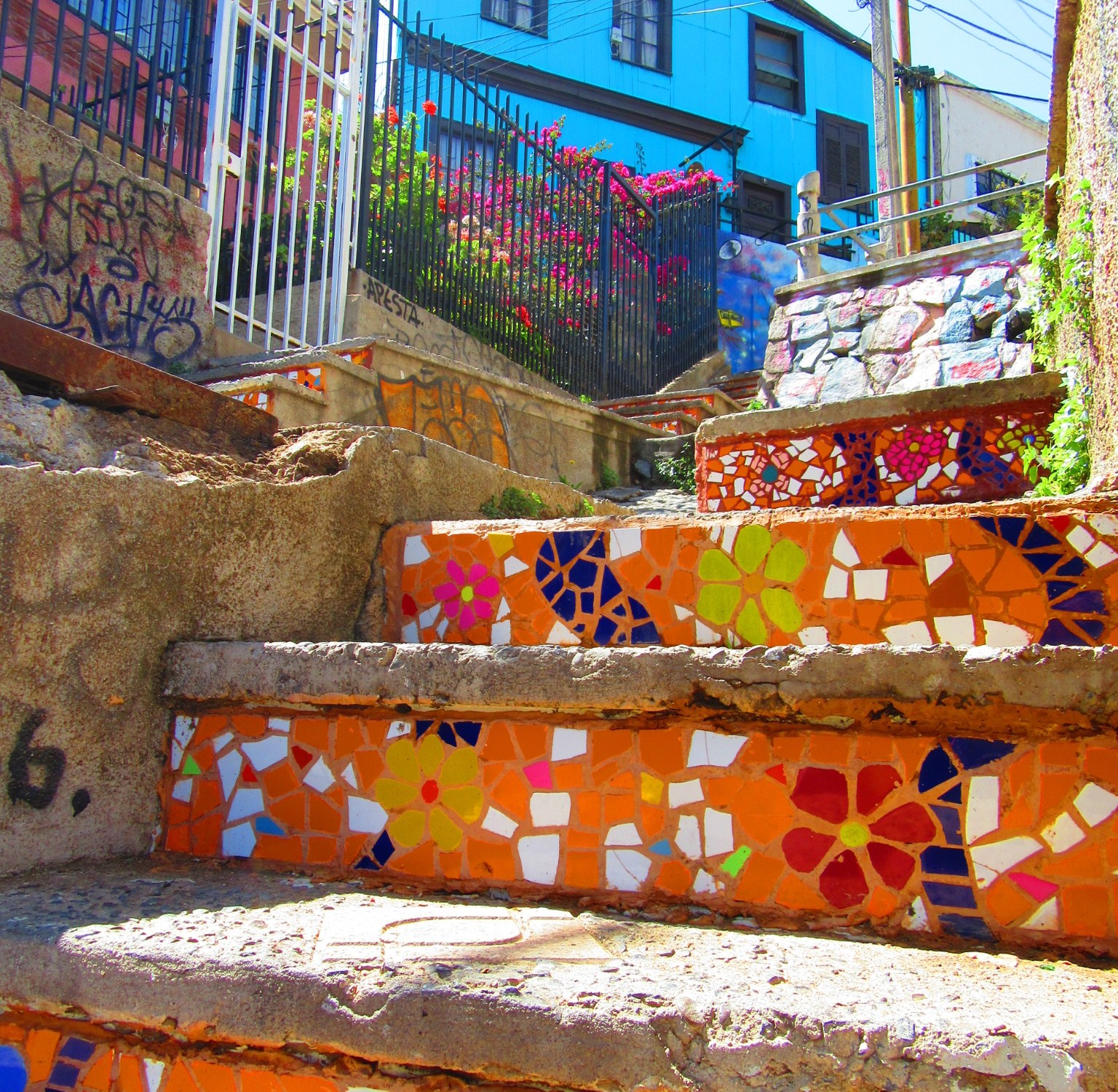
I decided on a detour to Valparaiso for one night as Antonio & Antonio had urged me that I could not leave Chile without having visited it. They were right. It’s a lovely seaside town with 45 ‘cerros’, hills, which rise up from the sea. During the gold rush times in the second half of the 19th century, Valparaiso was an important pit stop for ships coming up from Europe to California and further to the U.S. and Canadian west coast. Its heydays ended with the opening of the Panama Canal in 1914. Today, Valparaiso is famous for its colourful street art and art outlets. I enjoyed another free walking tour and a visit to the Pablo Neruda house, Chile’s well known poet and literature Nobel laureate. In the evening, I stayed in my hostel which had a fantastic view over the nightlights of Valparaiso. I drank my first Pisco Sour of the trip and enjoyed being alone and catching up on my blog and correspondence.
I did more of this the following day when I returned to Santiago, but also managed to squeeze in a little cultural agenda point by visiting the Precolumbian museum. It is very well presented and I had a first introduction to Inca artefacts. My favourite was a skirt of strings with knots in it that the Incan accountant would wear to keep track of everything from population to the stock of Lamas. Thankfully things have moved on from then and I don’t have to learn the knot language to practise my profession.
The next morning, I took a two hour flight to the north of Chile, which saved me a 24 hour bus journey. In San Pedro de Atacama, I met Christian Bariloche again and decided to start the Salar de Uyuni tour into Bolivia straight away the next day. It was raining in San Pedro and most activities were therefore cancelled. What a luck: I go to the most arid desert in the world and it’s raining! Christian and I nevertheless walked to a viewpoint and had a glimpse of the desert. It reminded me of Tatacoa in Colombia but on a much bigger scale. Shame I didn’t explore it more. I did manage to meet up with Sabine though, a friend from Barcelona, who is also travelling South America at the moment. We celebrated our reunion till late in the night at a party outside of San Pedro. Luckily I didn’t miss the start of the Uyuni tour at 7am the next day!
 Posted with Blogsy
 lisaimwunderland.com