


16 to 21 January 2016
Uruguay was the only part I was supposed to organise. I had booked the accommodation in Montevideo (one night) and the Estancia La Paz in the northwest of the country near Paysandu (two nights). But I had ignored the travel arrangements and it nearly went wrong with the prospect of cutting short the stay at the estancia. In the end I found a way that worked with a long journey leaving the Estancia at 6:30am and finally arriving in Puerto Madero at 2pm the following day. Mum didn’t complain once! We were actually laughing a lot at the way we were given our complementary dinner in the bus, a Schnitzel (Milanesa), which I quite enjoyed, but mum decided to go Vegetarian looking at it. We also had two nice stops before and after the ferry ride, in Colonia, Uruguay, and Puerto Madero, Buenos Aires.
Rewind: Uruguay. Lena had said Montevideo was worth a day trip, my friend Ferdi called it a Freiburg in South America. Mum and I were both not sure were those ideas came from. When we walked through the historic centre of Montevideo on a Saturday afternoon, it was deserted and desolate. It reminded me a bit of Havana in terms of its run down buildings, although the state of Havana’s houses is worse. I had heard that lots of American movies taking place in Havana are actually filmed in Montevideo. Makes sense.
Life came to the city in the wrong moment, after midnight when the club next door to the hotel started buzzing, but we had to get up at 5am to catch our bus to Paysandu. The party was still on when we got onto way, lots of Schnapsleichen in the streets.
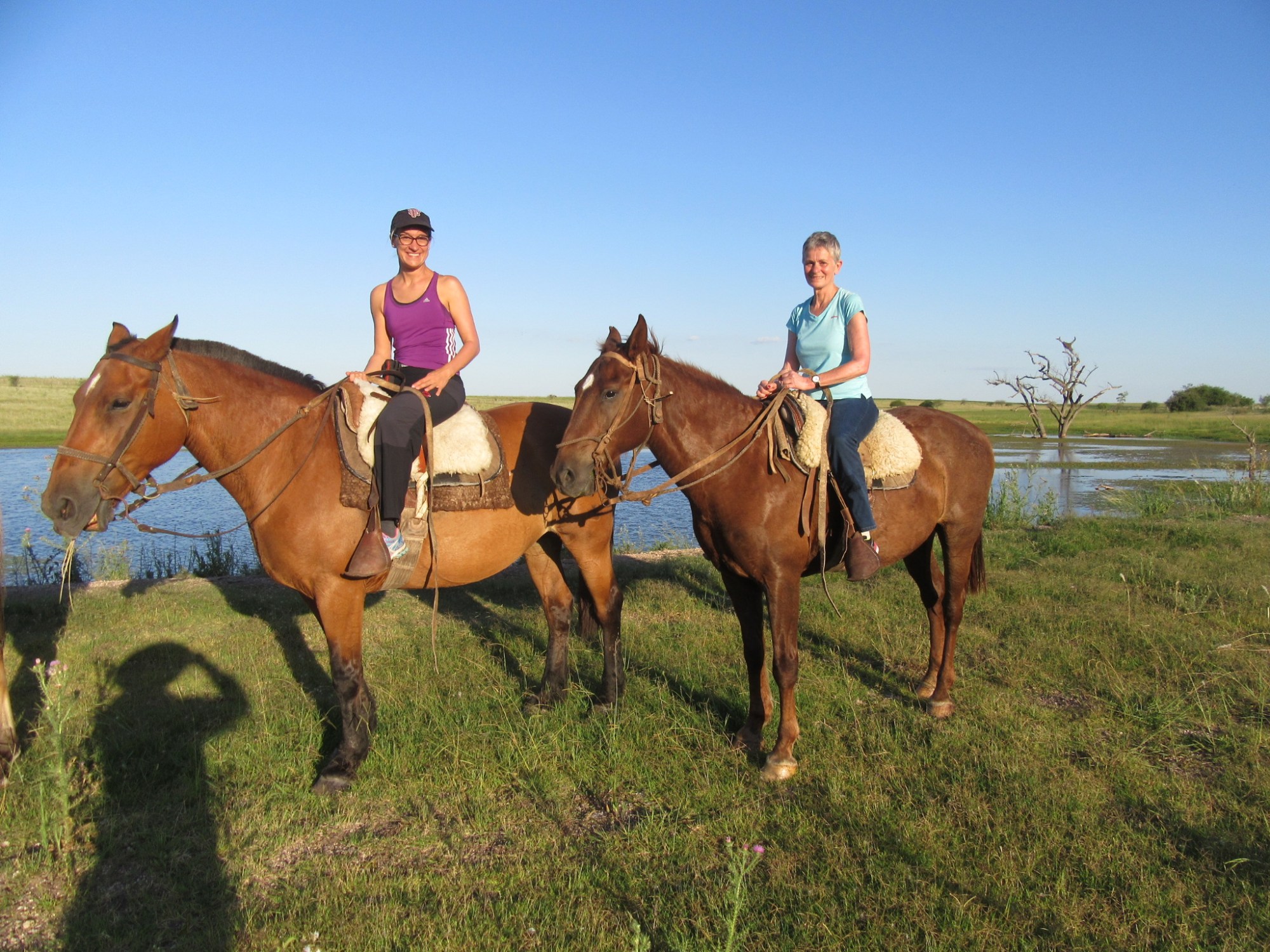
The Estancia La Paz was exactly what she promised in her name and surpassed my high expectations. It was a wonderfully peaceful place. It reminded mum and me of St Pont near Vichy in France, where we had spent summer holidays at my dad’s vacation home. The landscape is similar and even the mild Charolais cattle was here. The Belgium parents of Anne, who is running the estancia, had brought the cattle breed from France. It is known for its succulent meat. Today, a lot of the land near the estancia is not dedicated to cattle, but to soya farming. We passed endless soya fields on our bus journey, and also rode through many on our horse excursion on our second day on the Estancia. Mum had been nervous because of the horse ride the entire day, but in the end enjoyed it very much and was glad we had opted for the activity. We felt like grand estate owners scaling our territory of rolling hills, waterholes, fertile fields, old trees and endless birds. I even saw a storch.
We spent the nearly unbearably hot days at the pool, catching up with reading and writing. I love pool days! In the evening we went for a walk around the fields. Malik, the dog, accompanied us. He also came with me on my early morning run the next day at 6am before the heat broke out. I enjoyed running on the straight dusty road so much with all the bird songs around me that I ran for 10k, a distance I had not done in a long time. My highlight was an owl flying next to me, landing and hauling at me from a fence post.
The evenings were clear and a fresh air cooled everything down. Lots of glowflies (Glühwürmchen) let the place appear magical. And big zappos came out. I was tempted to kiss them to see if they turned into Prince Charming. It seemed possible in this surrounding. Instead I put my energy into deciphering the star formation with help of the app that dad had downloaded for me. After intense studying I thought I had identified the Orion formation, but it is to be confirmed by dad.
Wind forward: Puerto Madryn. The town was busy with Argentinian families on their summer holidays. The beach was packed, the usual noise of children playing, beachball tic-toc, waves breaking, music from the cafes and a stage setting up for an evening’s concert. Mum and I walked along the water to the excellent maritime museum introducing us to the local sea wildlife and geographical conditions. I thought the most fascinating fact was that for the Lobos Marinos, the sea lions, mating starts only one to three weeks after the babies are born. This means that female sea lions are only NOT pregnant for about 19 days of the year. I do not want to be a female sea lion in my next life! Plus when we saw the whole scenario live the next day at Punta Norte on the Peninsula, the 300kg heavy male sea lion left his partner, about 100kg, completely flat after the act.
We had hired a car for the day and drove around the national park Peninsula Valdez to the various wildlife viewing points. The sea lion colonies were definitely the most impressive sight. It was a spectacle: the old established males defending their harem of 4 to 16 females, young males attacking, trying to break in or fighting with other youngsters, roaring loudly in the process. Females caressing their lion king or nursing their baby. Babies crying loudly for attention and looking for protection and love. And then there was the odd male outsider who was lazily lying in the sun apart from the rest a la: ‘I am out of here, I am done with this madness. I am having my peace alone without the rest.’
We also saw a Magellan Penguin colony, which was quiet and orderly after the sea lion tumult. Guanacos and Rheas, a type of ostrich, crossed the road in front of us. And when we were just about to head back to Puerto Madryn, we saw an Orca! He was gone too quickly though before I could take a picture.
Time to get back, a storm was brewing up on the horizon, a dark wall broken up by lightning. We didn’t quite make it out of the peninsula before it reached us, but at least we had left the dirt road, which would have turned treacherous. Just when mum pointed out that the car in front of us had put on their warning lights, the storm hit us. The rain came down so heavily and the wind was so strong that I could not see anything anymore, not a single bit of road in front of me, and was scared the car would be lifted or turned over. We stopped on the hard shoulder and waited for about 20minutes before driving on. It was little compared to what must have happened back at Puerto Madryn. Whole streets were washed away, flooded, cars stuck in streams of water, shopowners mopping water in disbelief or having closed their business for the day. We managed to get as close as two blocks away from the rental agency, parked the car and made our way home through the chaos as well as we could. Luckily, the restaurant where we had reserved a table was open!
We handed the car back the next morning. The rental car lady was in a bad state as the agency had been flooded (“un desastre!”), so our late return was the least of her concerns. Mum and I then embarked on a treasure hunt to buy the missing bus tickets for our connections at the town of Caleta Oliva that night. No success at the obvious point, the agencies at the bus terminal. No success over the Internet with Plataforma10, a nationwide bus ticket vendor. But they had physical agencies in town! Internet said Calle Rivadavia 313. Walking up and down the road: no agencies at 313, just the migration office. They told us that the agency had moved to around the corner. It had and we could buy the tickets with them! But: only payment in cash. Getting enough cash from a cash machine is a difficult task in Argentina. Usually there are long queues and you can then withdraw a maximum £25, if any at all. Cash machine at Banco Nacional de Argentina a disappointment as always. Find another cash machine. Finally success at Banco de Patagonia as always. Back to travel agency. Done! We had found the treasure, we had the tickets in our pockets! Relieved, we had lunch with a celebratory shandy. Shame that it turned out in vain in the next level of the game as we missed our bus connection that night in Caleta Oliva. But this is a story for the next blog!
 Posted with Blogsy
 lisaimwunderland.com